Man sitting in a gym after training, evaluating his progress

THE PROBLEMS · 02

You’ve trained for years. Why do you still look soft?

Why do I still look soft after years of working out? Usually your training, eating, and recovery just aren’t set up to change how you look.

Your training may not be progressing enough to keep building muscle. You may not actually know whether you are eating enough protein and total food to support that goal. And each time you get lean, it may be through a diet you cannot sustain, so the fat comes back.

Effort is rarely the problem. Being consistent and making progress are two different things.

01

What “soft” actually means

“Skinny fat” isn’t a medical term. Cleveland Clinic describes it as a normal BMI alongside things like a high body fat percentage, and notes that low activity lets fat build up while lean muscle shrinks. BMI can’t see body fat at all. [1]

That’s why it’s so frustrating: by every number you check, you’re fine. In the mirror, and in a fitted shirt, you’re not.

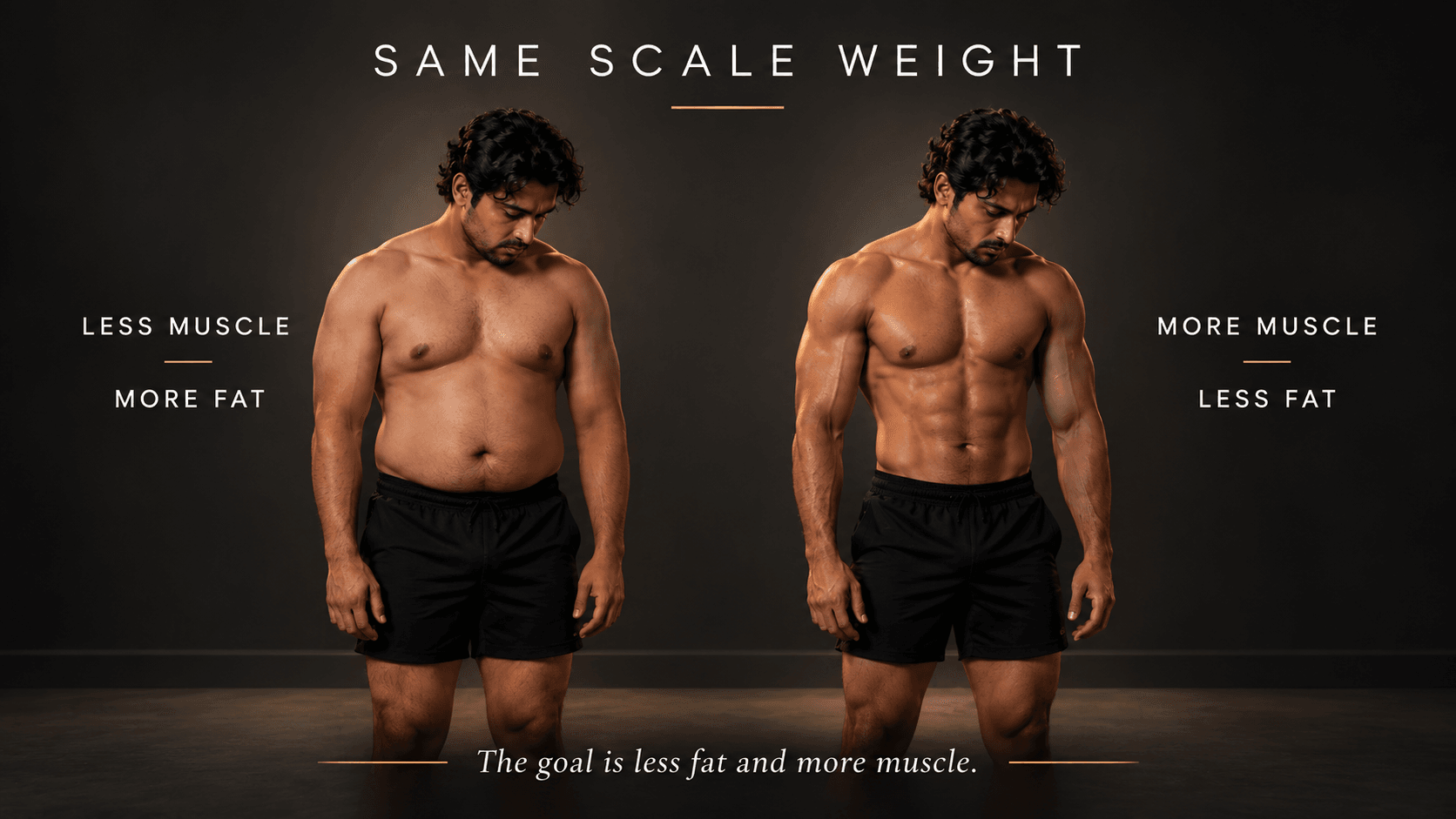
If your weight is already in a healthy range, losing more of it isn’t the fix. The goal is less fat and more muscle. [1]

Two male physiques at the same scale weight with different proportions of muscle and body fat
02

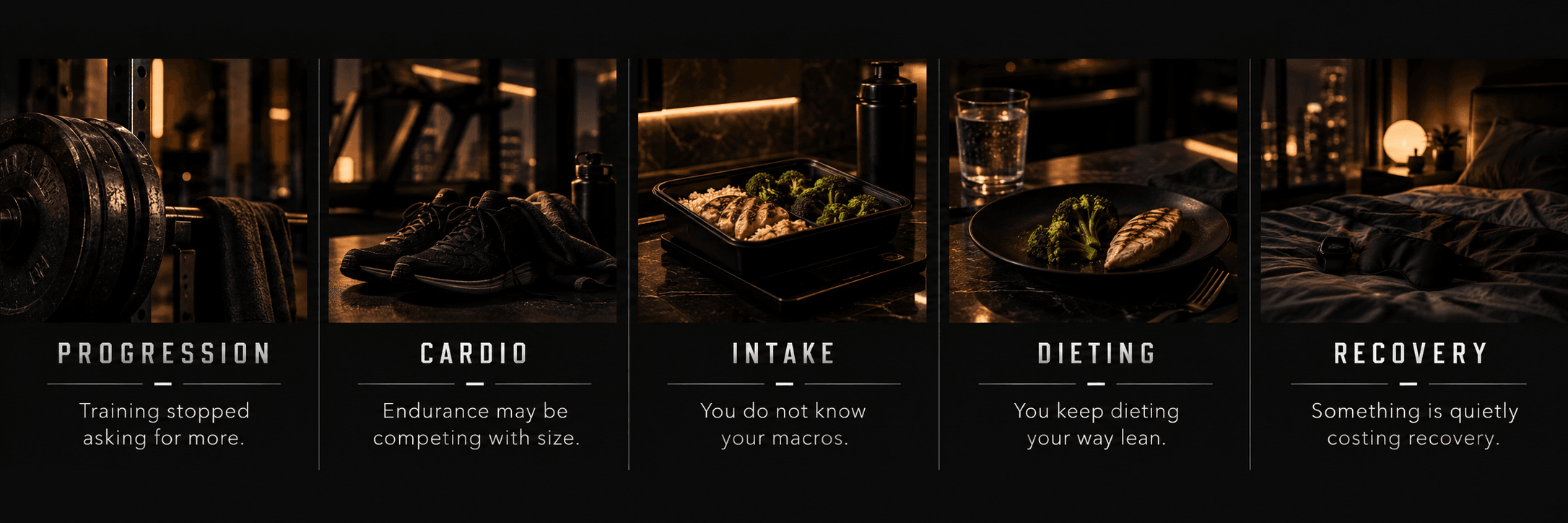
Five reasons you can still look soft after years of training

01 PROGRESSION

Your training stopped asking for more.

Muscle growth generally responds to progressively challenging resistance training and enough weekly volume. Doing the same routine for years can keep you active without giving your body a strong reason to build more muscle.

A 2026 meta-analysis covering 67 studies found that hypertrophy increased as weekly training volume increased, but with diminishing returns. [2] Plenty of men who train “consistently” couldn’t tell you their weekly sets, because nothing is written down.

02 CARDIO

Your cardio may be competing with the goal.

Cardio isn’t the enemy. But type, dose, and priority matter.

Combining endurance and resistance training can interfere with some adaptations under some conditions. An older meta-analysis found running reduced muscle and strength gains more than cycling; a newer one found little effect on overall muscle size or maximal strength, with the clearest cost to explosive strength. [3]

If your program is mostly endurance work with some lifting on the side, the bigger issue may simply be that muscle growth isn’t actually the program’s priority.

03 DIETING

You keep dieting your way lean.

The pattern goes like this: you cut hard, see your abs for a few weeks, can’t hold it, and rebound. Each cycle you end up roughly where you started.

The better route is body recomposition: losing fat while building muscle. It used to be thought of as something only beginners could do. A 2020 review found it also happens in people who already train, driven by progressive resistance training and sound nutrition. [4]

04 RECOVERY

Something is quietly costing your recovery.

Alcohol is one example. A 2025 systematic review and meta-analysis found that alcohol delayed REM sleep and reduced the amount of REM sleep, with disruption increasing as the dose increased. [5]

If your sleep and recovery are consistently poor, your training may not be the only variable worth looking at.

05 INTAKE

You don’t actually know your intake.

Protein matters, but it is only one part of the picture. A meta-analysis of 49 studies with 1,863 participants found that the average muscle-building benefit of higher protein intake leveled off around 1.6 grams per kilogram of body weight per day—roughly 0.7 grams per pound. [6] That is an average, not a hard ceiling, and protein needs can rise when someone is already lean and dieting.

A systematic review of lean, resistance-trained athletes in calorie deficits suggested roughly 2.3 to 3.1 grams per kilogram of fat-free mass per day, scaled upward as the deficit gets more severe and the athlete gets leaner. [7]

But protein alone does not tell you whether your nutrition matches the goal. If you do not know roughly how much protein, carbohydrate, fat, and total energy you are taking in across a normal week, it is hard to tell whether you are eating to build muscle, lose fat, or simply maintain where you are. “Eating healthy” and eating for a specific body-composition goal are not the same thing.

03

What most men try first, and why it doesn’t hold

MORE CARDIO

If endurance work is already competing with muscle growth, adding more of it does not solve the underlying problem.

A HARDER DIET

Cutting deeper can make you leaner briefly. It does not build the muscle that changes how your body looks, and if the diet is too aggressive to sustain, the result usually does not last.

A NEW PROGRAM

Switching programs feels like progress. Without a log, you cannot tell whether any of them were working.

04

What I got wrong

Marc Collier is the founder of MANTH and the first person to work through the system that became the MANTH Sequence.

BEFORE

Marc before changes to his training and nutrition

For most of my adult life my body went in cycles, and none of them stuck. In my mid-twenties I trained with bodyweight work and running. I had abs some of the time and looked skinny-athletic. In my early thirties I switched to Olympic weightlifting and got strong for the first time, but my nutrition wasn’t locked in and the abs disappeared. Then I got injured, Covid hit, and I went back to bodyweight work and running. I got soft.

I tried to fix it the way most men do: I locked in a strict diet and got lean again, down to 141 pounds. It wasn’t sustainable. When I eased off, I ended up athletic but soft, which made no sense for how consistently I was working out.

What finally worked looked backward at the time. I started eating more—more calories overall and real carbs, which I had avoided since I was an overweight kid.

Part of what had held me back was the fear that eating more protein or more calories would make me bulky, fat, round, or just bigger in the wrong way. In retrospect, that fear was overblown. You do not accidentally stumble into a bodybuilder physique because you increased your protein or stopped undereating. Building substantial muscularity takes years of specific resistance training, nutrition, and consistency.

AFTER

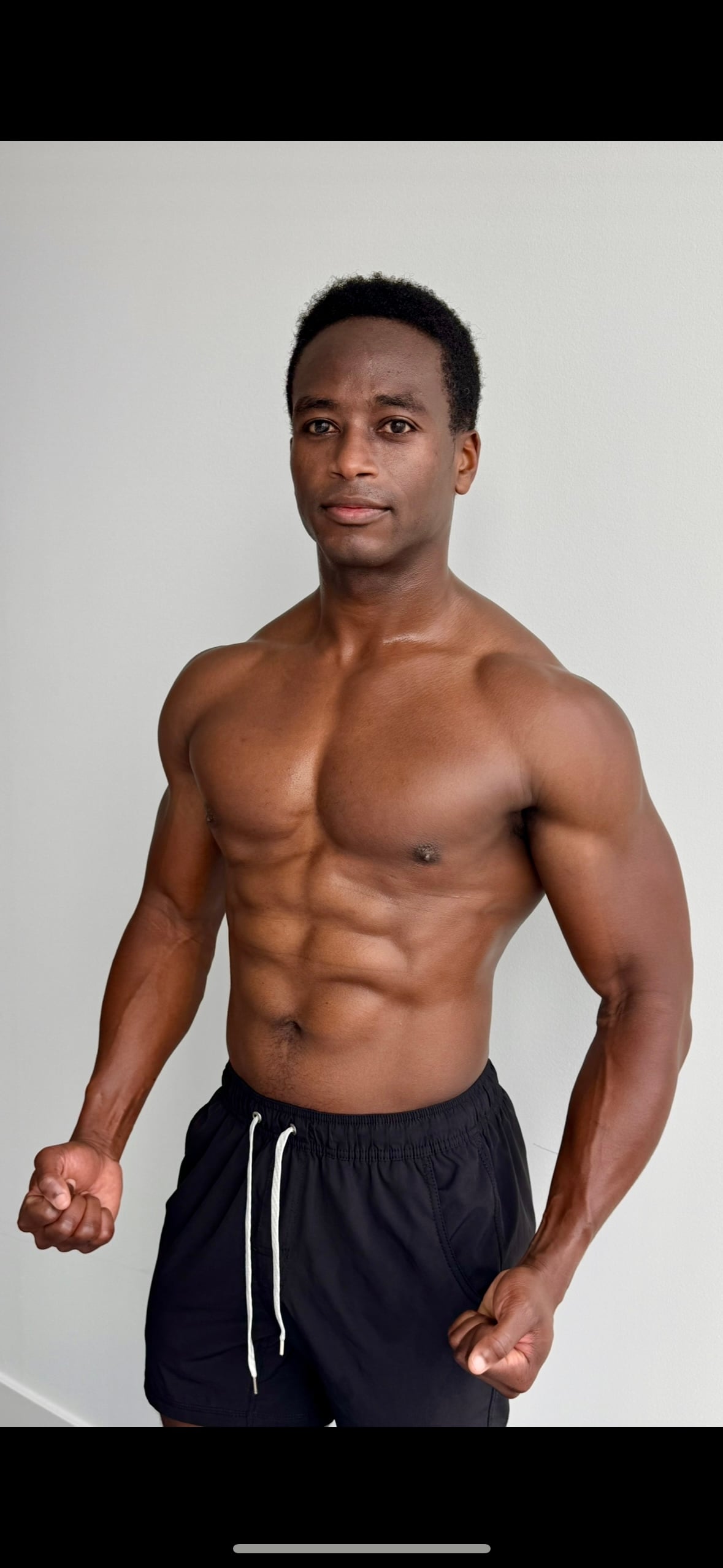
Marc after changes to his training and nutrition

My results, from my training and nutrition. Yours will depend on your starting point and how consistently you do the work.

My weight dropped and my abs came back, but I was thin. So I moved from bodyweight work to lifting weights and from not tracking anything to writing down every session.

The log changed everything. When I could see exactly what I had lifted the week before, I knew what I had to beat.

Early on I stayed in a strength range of 3 to 5 sets of 5 to 6 reps. When I first went back to the barbell I was struggling to do reps at 135 pounds on the bench. The first bench press in my workout spreadsheet is 165. It’s now 230, and I’ve added 19 pounds of lean muscle.

My abs stay year-round now, not for a few weeks after a crash diet. Stopping drinking helped more than I expected: fewer lost days, much better sleep, and, for me personally, less of the joint pain that had been throwing off how I moved.

05

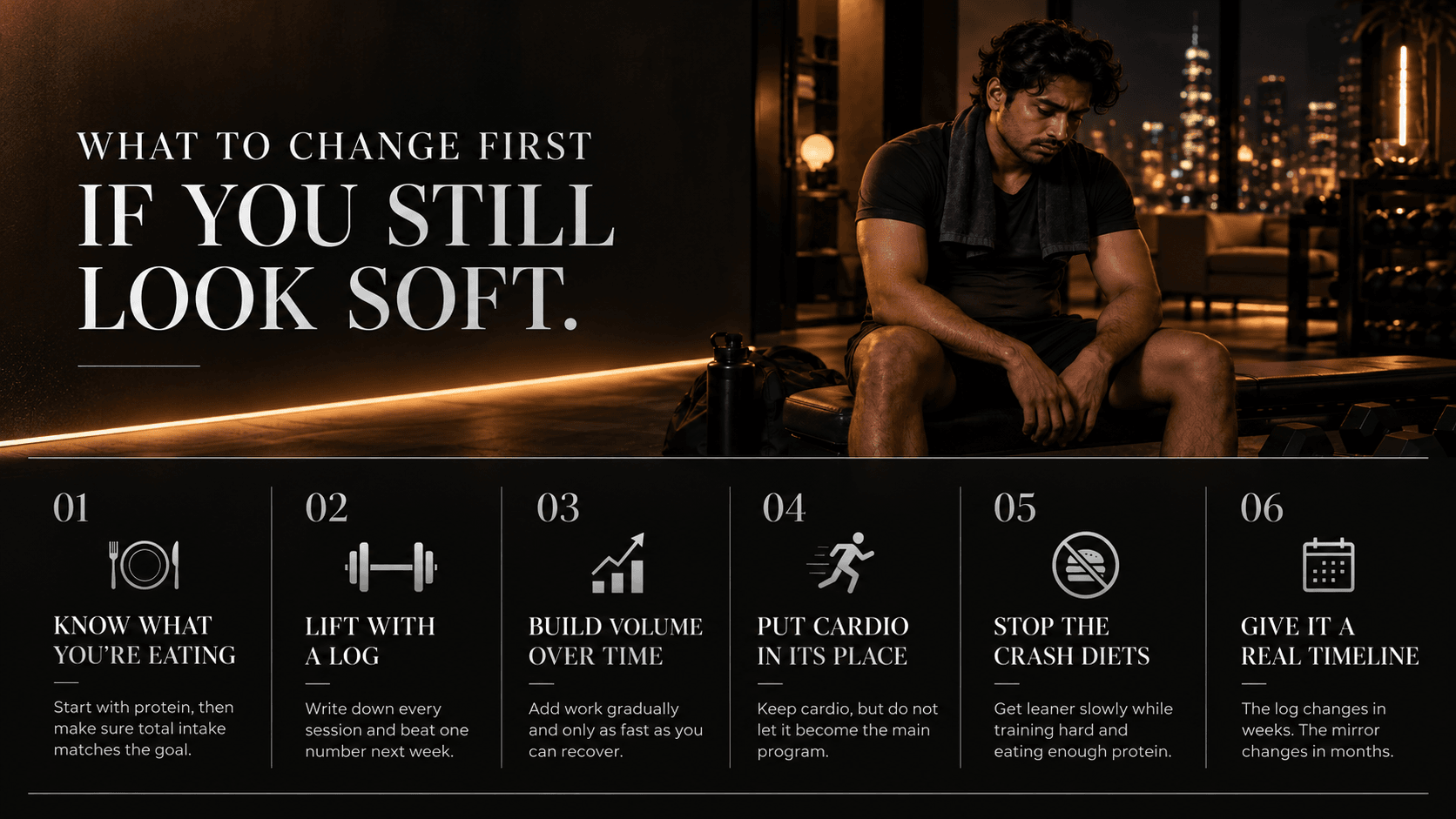
What to change first if you still look soft

If you’re already training consistently, the next problem may not be the workout. It may be what you’re eating.

  1. 01

    Know what you’re eating, protein first.

    Start with a reliable protein baseline and a clearer picture of your normal intake. You do not need to track everything forever, but if your body composition is not changing, guessing eventually stops being useful.

  2. 02

    Lift with a log.

    Write down every session: exercise, weight, sets, reps. Next week, beat one number. That’s progressive overload, and it’s impossible to do from memory.

  3. 03

    Build volume over time.

    More weekly training volume generally produces more muscle growth, but the returns diminish as volume rises. [2] Start with an amount you can recover from and build from there.

  4. 04

    Put cardio in its place.

    Keep it if you enjoy it or want it for cardiovascular fitness. Just don’t let endurance work become the main program while you’re trying to prioritize muscle growth. [3]

  5. 05

    Stop the crash diets.

    Get leaner slowly, while training hard and eating enough protein, so the muscle stays and the result lasts. [4]

  6. 06

    Give it a real timeline.

    Strength shows up in your log within weeks. The mirror takes months.

06

What Carter does with this

Carter, MANTH’s AI personal development coach, starts with your actual history: how long you’ve trained, what you do now, whether you track your lifts, what you typically eat, how much protein you’re getting, whether you have any reliable sense of your total intake, and how much cardio you do.

Most men who look soft after years of training are missing one or two specific pieces, not everything.

In MANTH, that work lives in Fitness and Nutrition.

Then he picks the one change that matters most—often getting protein and total intake under control or finally tracking your training—and adds the next one once the first is running.

07

When it isn't a coaching problem

If you’ve been training and eating well for months with no change, and you’re also dealing with persistent fatigue, low sex drive, mood changes, or other unexplained symptoms, talk with a clinician rather than assuming the answer is another training change. A clinician can decide whether testing is appropriate.

Carter flags that boundary rather than trying to diagnose it.

COACHING CAN ADDRESS*

  • Training
  • Nutrition
  • Recovery

* If those pieces are in place and persistent symptoms remain, the problem may be outside coaching.

TALK TO A CLINICIAN IF

  • Persistent fatigue
  • Low sex drive
  • Mood changes
  • Other unexplained symptoms

Find your starting point.

Answer five questions. See where to start — and why.

Find Your Starting Point

Or start now.

Start Now
08

Common questions

Sources

  1. 1.Cleveland Clinic, Health Essentials. “Skinny fat.” https://health.clevelandclinic.org/skinny-fat
  2. 2.Pelland JC, Remmert JF, Robinson ZP, Hinson SR, Zourdos MC. “The Resistance Training Dose Response: Meta-Regressions Exploring the Effects of Weekly Volume and Frequency on Muscle Hypertrophy and Strength Gains.” Sports Medicine. 2026;56(2):481–505. https://pubmed.ncbi.nlm.nih.gov/41343037/
  3. 3.Wilson JM, et al. “Concurrent training: a meta-analysis examining interference of aerobic and resistance exercises.” Journal of Strength & Conditioning Research. 2012;26(8):2293–2307. https://pubmed.ncbi.nlm.nih.gov/22002517/Schumann M, et al. “Compatibility of Concurrent Aerobic and Strength Training for Skeletal Muscle Size and Function: An Updated Systematic Review and Meta-Analysis.” Sports Medicine. 2022;52(3):601–612. https://pubmed.ncbi.nlm.nih.gov/34757594/
  4. 4.Barakat C, et al. “Body recomposition: can trained individuals build muscle and lose fat at the same time?” Strength and Conditioning Journal. 2020;42(5):7–21. https://doi.org/10.1519/SSC.0000000000000584
  5. 5.Gardiner C, et al. “The effect of alcohol on subsequent sleep in healthy adults: a systematic review and meta-analysis.” Sleep Medicine Reviews. 2025;80:102030. https://pubmed.ncbi.nlm.nih.gov/39631226/
  6. 6.Morton RW, et al. “A systematic review, meta-analysis and meta-regression of the effect of protein supplementation on resistance training-induced gains in muscle mass and strength in healthy adults.” British Journal of Sports Medicine. 2018;52:376–384. https://openrepository.aut.ac.nz/items/8dea98a4-4e37-4c60-be43-4b6ece0bd9a5
  7. 7.Helms ER, Zinn C, Rowlands DS, Brown SR. “A systematic review of dietary protein during caloric restriction in resistance trained lean athletes: a case for higher intakes.” International Journal of Sport Nutrition and Exercise Metabolism. 2014;24(2):127–138. https://pubmed.ncbi.nlm.nih.gov/24092765/